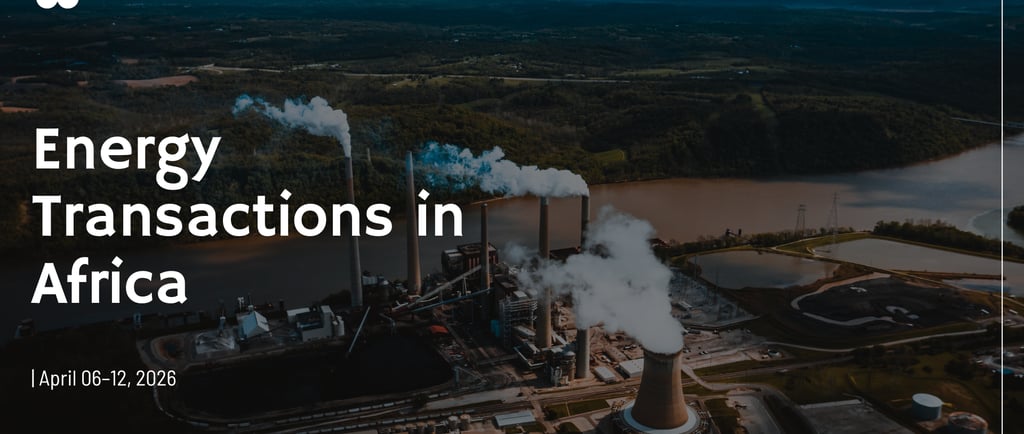
Energy Transactions in Africa | April 6–12, 2026
Cyrille Tetougueni
4/13/20262 min read
Week 14 combined three simultaneous shifts:
• Brent crude fell ~12% within days
• Major upstream discoveries reshaped the Eastern Mediterranean and Libya
• Africa deployed its largest-ever energy shock-response financing vehicle
Markets corrected. Capital repositioned. Projects advanced.
I) Oil & Gas: Price Reset, Strategic Acceleration
🇪🇬 Egypt — 2 Tcf Gas Discovery (Eni/bp, Temsah Concession)
Eni and bp confirmed a ~2 Tcf gas discovery (Denise W-1) offshore Egypt.
• 130 million barrels of condensate
• ~50 m net pay
• <10 km from existing infrastructure
• Fast-track tie-back potential
Egypt’s domestic production has fallen below 4 Bcf/d (from ~6 Bcf/d in 2022).
This discovery is not optional — it is structural for supply recovery.
🇱🇾 Libya — Three Discoveries Across Three Basins
Libya’s NOC announced:
• Offshore gas discovery (Eni)
• Oil discovery in Murzuq Basin (Repsol)
• Gas + condensate discovery in Ghadames Basin (Sonatrach)
Multiple basins, multiple operators, single week.
Libya’s upstream map remains underdeveloped relative to its potential.
🇳🇬 Nigeria — Dangote Refinery at Full 650,000 bpd Capacity
Africa’s largest refinery confirmed full throughput.
Exports of gasoline and urea accelerated across West, Central and East Africa amid Middle East supply disruptions.
This is the first time Africa’s refining system functions as a continental buffer at scale.
🇳🇬 Oando — $750M Drilling Campaign
Oando announced plans to raise up to $750M to drill ~100 wells across acquired assets.
Target: triple output from ~32,000 boed base.
Funding sources:
• Afreximbank
• Africa Finance Corporation
• Commodity traders (Vitol, Trafigura, Mercuria, Glencore)
• Gulf banks & private capital
West African independents are regaining capital access as geopolitical risk shifts funding appetite.
🇦🇫🌍 Pan-Africa — Afreximbank $10Bn Gulf Crisis Response Programme
Afreximbank launched a $10 billion emergency facility.
Four pillars:
• Fuel & essential import financing
• Pre-export finance for energy exporters
• Tourism & aviation support
• Infrastructure resilience acceleration
This is Africa’s largest coordinated crisis vehicle to date.
Energy volatility is now triggering continent-scale financial architecture.
II) Renewables: Structural Momentum
🇦🇫🌍 Africa — Record Renewable Growth (IRENA)
Africa added 11.3 GW in 2025 (+15.9%), its highest-ever annual increase.
Total installed renewable capacity now ~82 GW.
Despite record growth, Africa still accounts for only 1.6% of global additions.
Growth is accelerating — but from a low base.
🇲🇼 Malawi — Solar Supplying ~10% of National Grid
JCM Power’s 60 MW Salima plant (with InfraCo Africa) now contributes ~10% of Malawi’s generation when combined with a second plant.
Revenue innovation:
Electricity payments reinvested into agricultural exports generating USD hard currency.
A replicable model for FX-constrained markets.
🇿🇲 Zambia — 100 MW Hybrid Wind-Solar PPA (DZGM/Zesco)
Signed under Zambia’s IPP framework.
Objective:
Reduce >80% hydropower dependency following drought shocks.
Hybrid diversification is becoming policy priority, not aspiration.
🇦🇫🌍 AfDB / SEFA — $11.3M P-REC Mini-Grid Facility (14 Countries)
Pilot aggregation mechanism monetizing renewable energy certificates upfront for fragile states.
Targets:
• 71 MW new capacity
• 240,000 new connections
• ~856,000 beneficiaries
Mini-grid capital structuring is becoming more innovative.
Brent: The Reset
Brent fell from ~$112/bbl to ~$93.76 within days (~12%).
Drivers:
• US-Iran ceasefire signals
• Partial Strait of Hormuz reopening
• Saudi capacity impact (~600,000 bpd)
• EIA projection of ~$90/bbl Q2 average
For exporters (🇳🇬 🇱🇾 🇩🇿 🇦🇴):
Still above fiscal breakevens.
For importers:
Volatility remains destabilizing.
What Week 14 Reveals
1️⃣ Africa’s upstream basin potential remains active despite price corrections.
2️⃣ Egypt is moving aggressively to reverse its gas production decline.
3️⃣ Nigeria’s refining and independent upstream sector are structurally strengthening.
4️⃣ Afreximbank is emerging as Africa’s systemic energy shock absorber.
5️⃣ Renewable growth is accelerating — but financing innovation remains essential.
The Structural Signal
Oil prices corrected.
Exploration did not stop.
Renewables continued scaling.
Crisis capital was deployed at record size.
Energy volatility is no longer a pause signal.
It is a catalyst for repositioning.
Akili Energy Investment Forum 2025
Mélia Paris La Défense,
3, Boulevard de Neuilly. Courbevoie - Paris, France
contact@akilienergy.com
+33 67***
Subscribe to Akili Energy newsletter