
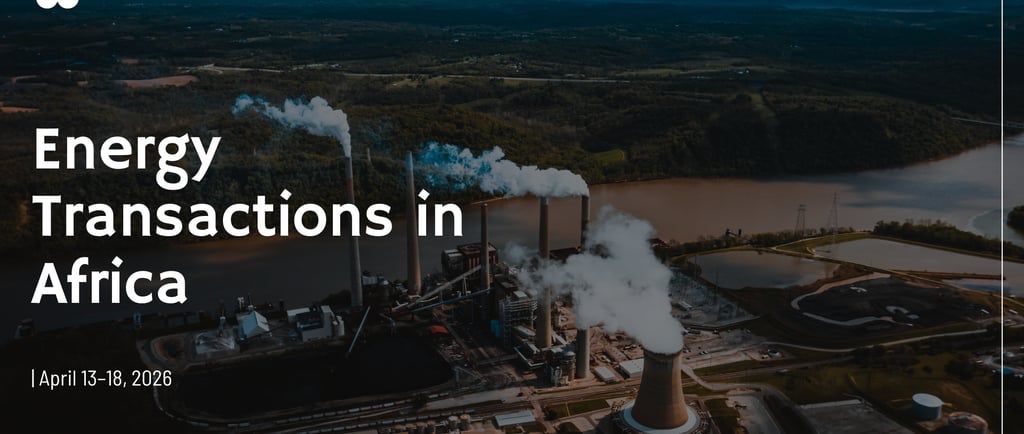
Energy Transactions in Africa | April 13–18, 2026
Cyrille Tetougueni, Ph.D, MBA
4/25/20262 min temps de lecture
Week 15 was defined by extreme oil price volatility and simultaneous acceleration in both renewables and upstream positioning.
Brent moved from above $120/bbl early in the week to ~$90/bbl by Friday — a near 9% single-day correction after Iran confirmed the Strait of Hormuz was open to commercial traffic.
Despite volatility, transactions did not pause.
They repositioned.
I) Oil & Gas: Volatility Meets Strategic Execution
🇳🇦 Namibia — bp Enters as Operator (Walvis Basin)
bp acquired a 60% operating interest in PEL97, PEL99, and PEL100 for $2.7M upfront (+$63M contingent).
This is a low-entry, high-optionality exploration move adjacent to the Orange Basin.
Two signals:
• Majors are still positioning in Namibia despite volatility
• Capital discipline is evident in deal structuring
Simultaneously, Namibia fast-tracked its Petroleum Amendment Bill at NIEC 2026 — aligning regulatory reform with exploration momentum.
Namibia is transitioning from frontier narrative to structured upstream execution.
🇨🇬 Republic of Congo — TotalEnergies Moho G (~100 MMbbl)
TotalEnergies confirmed a hydrocarbon discovery at Moho G (~100 MMbbl combined with Moho F).
Development strategy:
• Subsea tie-back to existing Moho FPUs
• Short-cycle development leveraging installed infrastructure
This is capital efficiency under volatile pricing.
🇪🇬 Egypt — Aphrodite 15-Year Gas Deal + $2B Pipeline
EGAS formalized a 15-year binding gas purchase agreement with Chevron, Shell, and NewMed for Cyprus’ Aphrodite field.
• ~3.7 tcf resource
• ~170 km subsea pipeline (~$2B+)
• First gas targeted ~2031
Egypt reinforces its position as the East Mediterranean processing hub.
Long-term gas infrastructure commitments continue despite short-term oil volatility.
🇳🇬 Nigeria — Production Rebound (1.6–1.7 MMbpd)
Nigeria’s output exceeded its OPEC+ quota.
Indigenous operators (Aradel, Heirs, Seplat) now contribute ~200,000 bpd following IOC divestments.
Domestic absorption via Dangote Refinery (~650,000 bpd capacity) strengthens internal demand dynamics.
Nigeria’s story is increasingly indigenous-operator driven.
II) Renewables: Financial Close Momentum
🇿🇦 South Africa — Mulilo Middlepunt (337 MW)
Financial close achieved under REIPPPP Bid Window 7.
• Investment: R4.4Bn (~$240M)
• 20-year PPA with NTCSA
• Tariff: R458/MWh (~$25/MWh — lowest ever procured under REIPPPP)
• 770 GWh/year expected output
This is record-low tariff pricing under competitive procurement.
Simultaneously:
🇿🇦 Mercury BESS (76 MW / 304 MWh) also reached financial close.
South Africa continues integrating storage alongside solar procurement.
🇨🇮 Côte d’Ivoire — AFC €43M Green Bond (66 MW Solar)
AFC disbursed €43M under the Poro Power Green Bond.
This is the first project-finance green bond in WAEMU.
Dual-currency (EUR/XOF) structuring reduces FX risk.
A replicable African-led capital model is emerging.
🇸🇳 Senegal — Renewable IPP Financial Close with Sénélec
An undisclosed utility-scale renewable IPP reached financial close under a long-term PPA.
Momentum continues under Senegal’s JETP framework.
🇿🇦 Envusa Energy — 140 MW Umsobomvu Wind COD
EDF/Anglo American JV confirmed COD within the 520 MW Koruson 2 cluster.
Industrial-linked renewable clusters are now operational reality.
What Week 15 Reveals
1️⃣ Oil volatility is no longer freezing upstream investment decisions.
2️⃣ Namibia is entering the major-operator phase with regulatory alignment.
3️⃣ Egypt is reinforcing long-term gas infrastructure positioning.
4️⃣ Indigenous Nigerian producers are consolidating structural relevance.
5️⃣ South Africa continues delivering record-low renewable tariffs while adding storage capacity.
6️⃣ African-structured green bond financing (🇨🇮) signals capital market maturation.
The Broader Signal
The correction from $120 to $90/bbl did not reverse positioning.
• Upstream capital remains active.
• Renewable procurement continues competitively.
• Gas infrastructure commitments are long-cycle and structural.
• African-led financing models are scaling.
Volatility reshapes margins.
It does not halt strategy.
Akili Energy Investment Forum 2026
Mélia Paris La Défense,
4 Esplanade du Général de Gaulle, 92400 Courbevoie
Structurer l’avenir énergétique de l’Afrique : capitaux, marchés et exécution.
contact@akilienergy.com
+33 6 64 76 66 68


Une initiative Akili Energy